
AI Workflows vs AI Agents: When to Use Each
By AgentWorks Team · AI agents for European teams
The team behind AgentWorks — building EU-compliant AI agents and multi-LLM workflows for European teams.
Reviewed July 6, 2026
TL;DR
Use a deterministic workflow when the steps are known and repeatable — you get predictable cost, latency and an inspectable path. Use a reasoning agent when the next step depends on judgement. The best systems combine both: a workflow for structure and guardrails, agents for the intelligent work inside each step. AgentWorks runs both patterns under one governance and billing model.
"Workflow" and "agent" get used interchangeably in AI marketing, but they solve different problems. Getting the distinction right is the difference between automation that behaves predictably and automation that quietly makes decisions you never sanctioned.
The core difference in one sentence
A workflow is a fixed sequence of steps you define in advance: step A runs, then B, then C, in the same order every time. An agent is given a goal and decides for itself which steps to take, in what order, and when to stop.
Put another way: a workflow follows your plan; an agent makes its own plan. Workflows are deterministic — the same input produces the same path through the system. Agents are adaptive — they reason over the situation and choose actions, so two similar inputs can lead to different routes.
Neither is "better." They are tools for different shapes of work. The mistake teams make is reaching for a reasoning agent when a three-step workflow would have been faster, cheaper, and auditable — or scripting a rigid workflow for a task that genuinely needs judgement, then wondering why it breaks on every edge case.
When a deterministic workflow is the right tool
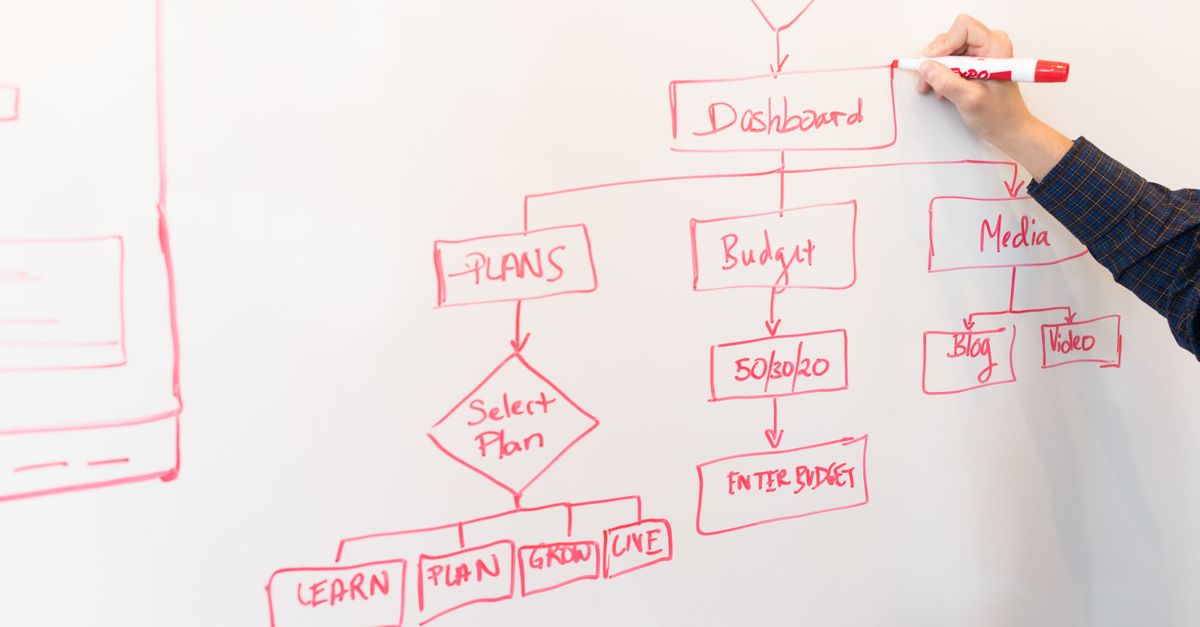
Choose a workflow when the steps are known and stable. If you can draw the process as a flowchart without any "it depends" branches that require interpretation, it belongs in a workflow.
Good candidates:
- Repeatable pipelines — research, then draft, then review, then publish. Each stage has a defined input and output.
- Scheduled reporting — pull data every Monday, summarise it, post to a channel.
- Structured transformations — take an incoming form, enrich it, write it to your CRM.
The advantages are exactly what you would expect from determinism: predictable cost, predictable latency, and a path you can inspect step by step. When something goes wrong, you know which stage failed. On AgentWorks, this is what the visual workflow builder is for — you chain agents into a pipeline (research → draft → review → publish), run it on a daily, weekly or monthly schedule or trigger it by webhook, and every step is logged with its own risk class. You get the reliability of a script with the language ability of a model at each node.
When you need a reasoning agent
Choose an agent when the right next step depends on what the model finds along the way. If the task requires reading a situation and deciding how to respond — rather than executing a pre-drawn plan — that is agent territory.
Good candidates:
- Open-ended questions where the sources and the answer path are not known in advance.
- Triage and routing where the correct handling depends on the content of each item.
- Interactive work where a person and the model go back and forth, and the model needs tools to help.
This is what AgentWorks' multi-LLM chat delivers: an agent can search the web, run cited Deep Research, generate images, execute code, and pull from your company knowledge base — deciding which tool fits the moment. You can switch models mid-conversation and build documents in a live canvas, exporting to Word, PowerPoint, Excel or PDF. The agent reasons; you stay in control of the outcome.
The pattern most teams actually need: both
In practice, the strongest systems are workflows with agents inside them. The workflow provides the guardrails — the fixed order, the checkpoints, the audit trail — and each step is powered by an agent that brings judgement to that specific stage.
Consider a content pipeline. The workflow guarantees that nothing publishes without passing through review. Within it, the research step is an agent that decides which sources to consult; the draft step is an agent that writes; the review step is an agent that checks against your guidelines. The structure is deterministic; the work inside each box is intelligent.
AgentWorks is built for exactly this combination. Start with a single agent in chat, promote a repeatable process into a scheduled multi-agent pipeline, and keep the reasoning where it adds value while the workflow enforces order. Browse the 50+ pre-built agents to see where a ready-made component fits, and reach for custom agents on the Pro plan when you need something specific.
Governance changes depending on which you pick
The workflow-versus-agent choice is not only about capability — it is about control. An agent that can choose its own actions can also choose an action you did not intend, which is why the more autonomy you grant, the more oversight you need around it.
AgentWorks applies the same governance to both patterns. Every agent carries a per-agent risk classification, state-changing actions can require human-in-the-loop approval before they execute, and everything writes to an immutable, append-only audit trail you can export as CSV or JSON. PII is masked at the gateway before any model sees it, data stays in the EU where those endpoints are offered, and model contracts are no-training and zero-retention. The platform is EU AI Act-ready — meaning the controls exist to help you meet your obligations; your actual risk tier still depends on how you use it. This matters more for agents than for workflows precisely because agents decide, so the approval gate and the log are where autonomy meets accountability.
Cost transparency follows the same logic. Whether a step runs inside a rigid workflow or an open-ended agent, the AUTO router sends each message to the cheapest capable model, and you see live per-run spend from a single € wallet with budgets set at org, team and user level.
Summary: Use a deterministic workflow when the steps are known and repeatable — you get predictable cost, latency and an inspectable path. Use a reasoning agent when the next step depends on judgement. The best systems combine both: a workflow for structure and guardrails, agents for the intelligent work inside each step. AgentWorks runs both patterns under one governance and billing model.
Frequently asked questions
Is an AI agent just a workflow with extra steps?
No. A workflow executes a sequence you defined in advance, so its path is fixed. An agent is given a goal and decides its own steps at runtime, so its path can vary with the input. The difference is who makes the plan — you, or the model.
Which is cheaper to run?
Workflows are generally more predictable on cost because the steps are fixed, so you can estimate spend up front. Agents can vary because they may take more or fewer steps depending on the task. On AgentWorks the AUTO router keeps per-step cost down by routing to the cheapest capable model in both cases, and live per-run spend is visible from one wallet.
Can I start with an agent and turn it into a workflow later?
Yes, and that is a common path. Many teams begin with an agent in chat to explore a task, then once the steps stabilise they promote the repeatable parts into a scheduled multi-agent pipeline on the Pro plan — keeping reasoning where it helps and locking in structure where it matters.
About the author
AgentWorks Team · AI agents for European teams
AgentWorks is an AI agent platform purpose-built for European teams that need EU AI Act-ready governance, multi-LLM choice across OpenAI, Anthropic, Google and Mistral, and transparent per-token € pricing.
Read more about AgentWorksRelated articles
Read article: How to Build Your First AI Agent Team  Best PracticesJuly 6, 20265 min read
How to Build Your First AI Agent Team
A step-by-step guide to composing multiple AI agents into a coordinated workflow that ships real, reviewable output.
Read more →Read article: AI Prompting for Business Users: Better Output, Faster  Best PracticesJuly 6, 20266 min read
AI Prompting for Business Users: Better Output, Faster
Practical prompting habits for non-technical teams working with multi-LLM chat, tools & company knowledge — clearer inputs, better results.
Read more →Read article: Company-Wide AI Adoption: A Practical Playbook  Best PracticesJuly 6, 20265 min read
Company-Wide AI Adoption: A Practical Playbook
A step-by-step playbook for rolling out AI across your whole company — start free, add shared knowledge and admin on Team, and keep governance built in.
Read more →