
Knowledge & RAG
Your AI Works With Your Data. Not Hallucinations.
Upload documents, sync Drive or SharePoint, get answers that show their source.
- €5 welcome credit
- EU AI Act & GDPR by design
- No credit card
Ingestion
Bring your data in
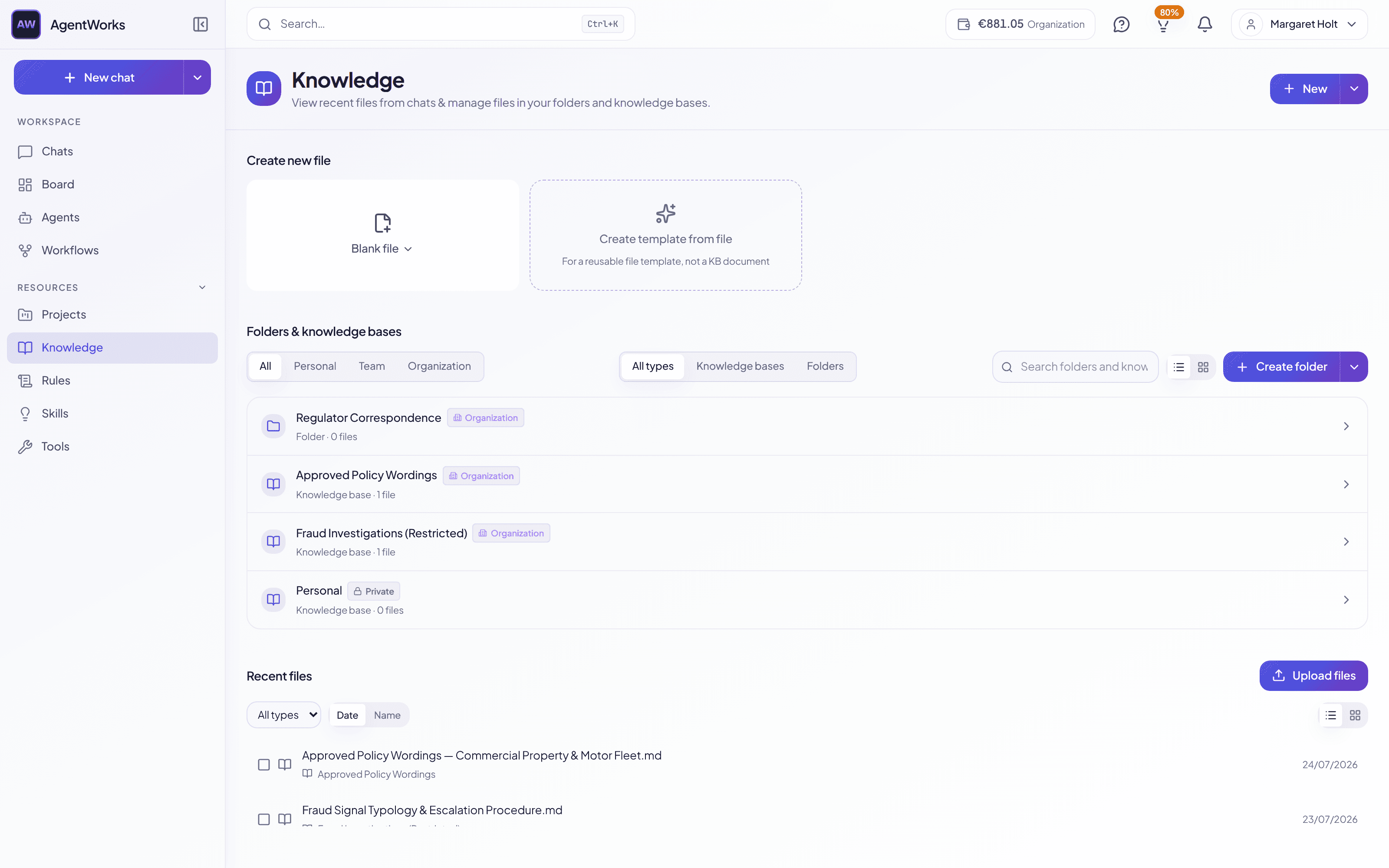
- Upload contracts, playbooks and procedures — text is extracted, chunked and embedded automatically.
- Scanned PDFs are read with OCR, so the archive nobody could search becomes searchable.
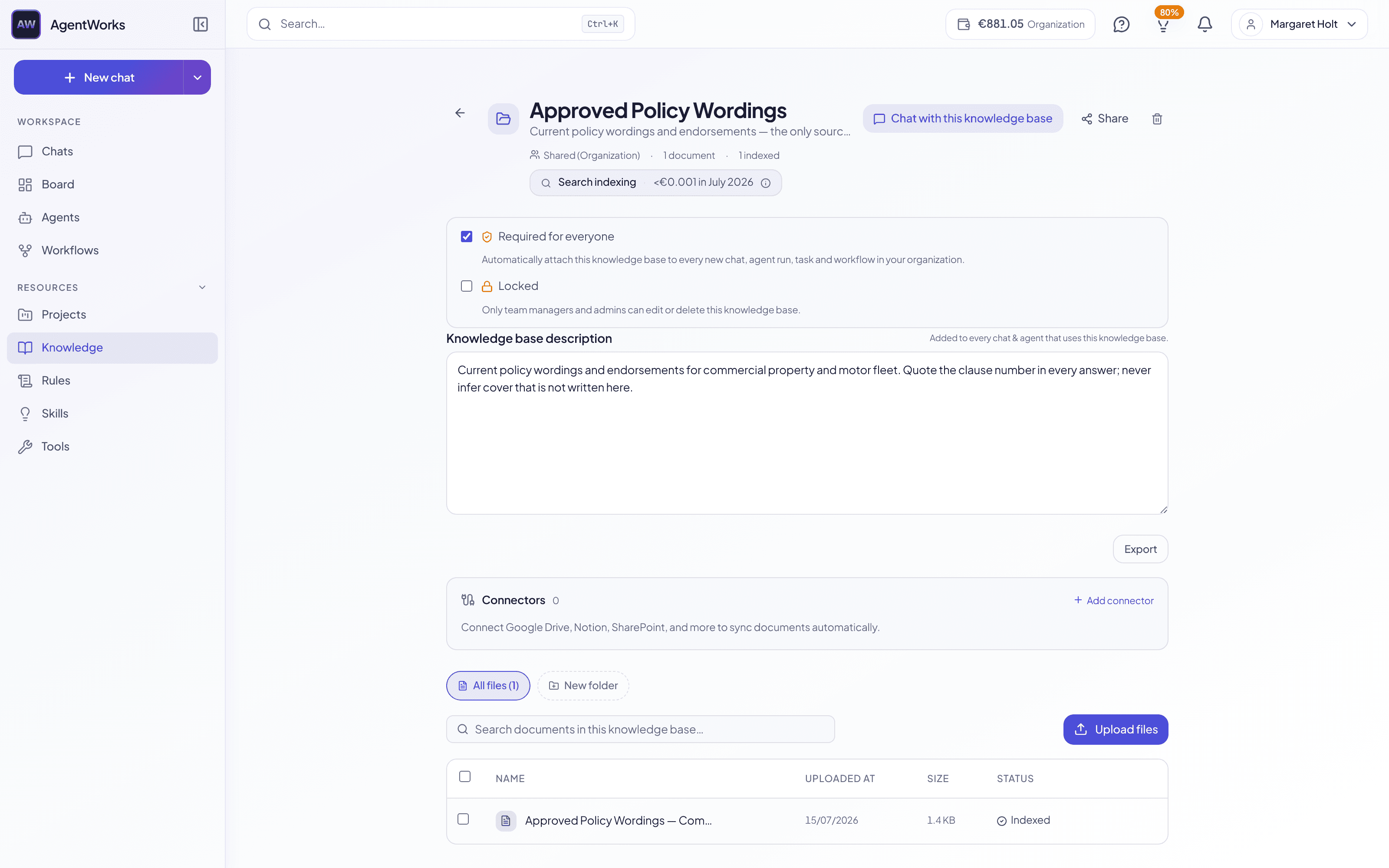
- Connect a Google Drive or SharePoint folder and it re-syncs on a schedule you set; each source shows when it last ran.
- Organise bases into folders and scope them to yourself, a team, or the whole organisation.
Drag in the documents your team already trusts, paste a URL, or connect the folder where the files actually live. AgentWorks extracts, chunks and indexes them for you — there is nothing to configure to get a useful first answer.
Retrieval
Retrieval that finds meaning
- Hybrid retrieval — meaning plus exact terms — fused into a single ranking, with a re-rank pass on longer questions.
- Structure-aware, overlapping chunks keep headings near their sections for coherent context.
- A relevance threshold leaves weak matches out instead of padding the prompt with noise.
- Vectors live in Postgres with pgvector — an EU-ready footprint that stays fast and auditable next to your data.
Someone asking "can I cancel early?" should find the clause headed "termination". Meaning-based and literal search run together and are fused into one ranking, so reworded questions still land on the right passage.
Grounding
Grounded in every agent, with citations
- Attach a knowledge base to a chat with #knowledge, or bind it to an agent so every run is grounded.
- Builders choose which corpora apply per agent, so customer data never bleeds into internal experiments.
- Answers cite the exact passage — reviewers can open the original and verify the wording.
- If something is not in your knowledge base, agents say so instead of inventing facts.
- Search your knowledge base from your own code too, over the REST API.
The same knowledge base can be attached to a chat, an agent or a project — one corpus, reused everywhere, answering with the passage it came from.
Under the hood
How retrieval works under the hood
Vector embeddings
Documents and pages are embedded with models suited to your plan. Vectors live in Postgres with pgvector so similarity search stays fast and auditable next to the rest of your data.
Chunking strategy
Text is split into overlapping chunks with sensible defaults for prose vs. tables. Structure-aware splits keep headings near their sections so retrieval returns coherent context.
Hybrid search, then re-rank
Meaning-based and literal matches are fetched in parallel and fused into one ranking, with an extra re-rank pass on longer questions — so the passage that actually answers wins, not the one that merely sounds similar. A relevance threshold keeps weak matches out instead of padding the prompt.
Refresh schedules
A connected Google Drive or SharePoint folder re-syncs on a cron schedule you set, so new and changed files are indexed without anyone remembering to re-upload. Each source shows when it last synced, so owners can see what has gone stale.
A briefing per knowledge base
Each knowledge base carries a short plain-language note about what it contains and how to use it. That note travels with the corpus into every chat and agent that attaches it — so a new colleague gets the same context as the person who built it.
Grounded, cited answers
Agents answer from the content you have indexed. If something is not in your knowledge base, they say so - instead of inventing facts.
See it in the product
Knowledge bases, upload, and ingestion status
Ground your AI in your own data
Upload documents, connect websites, and get grounded, cited answers in every agent.
Explore More Features
See how other platform capabilities work together.
Chat
One thread for every model, agent and tool you run
AI Agents
Start from 50+ templates, or build your own without code
Multi-Agent Pipelines
Chain agents into automated workflows
AI Tools
What agents can actually do — and the approval before they do it
Compliance
EU AI Act and GDPR compliance dashboard
Cost control
Live cost per run, budgets and caps that hold
Last updated: July 2026